
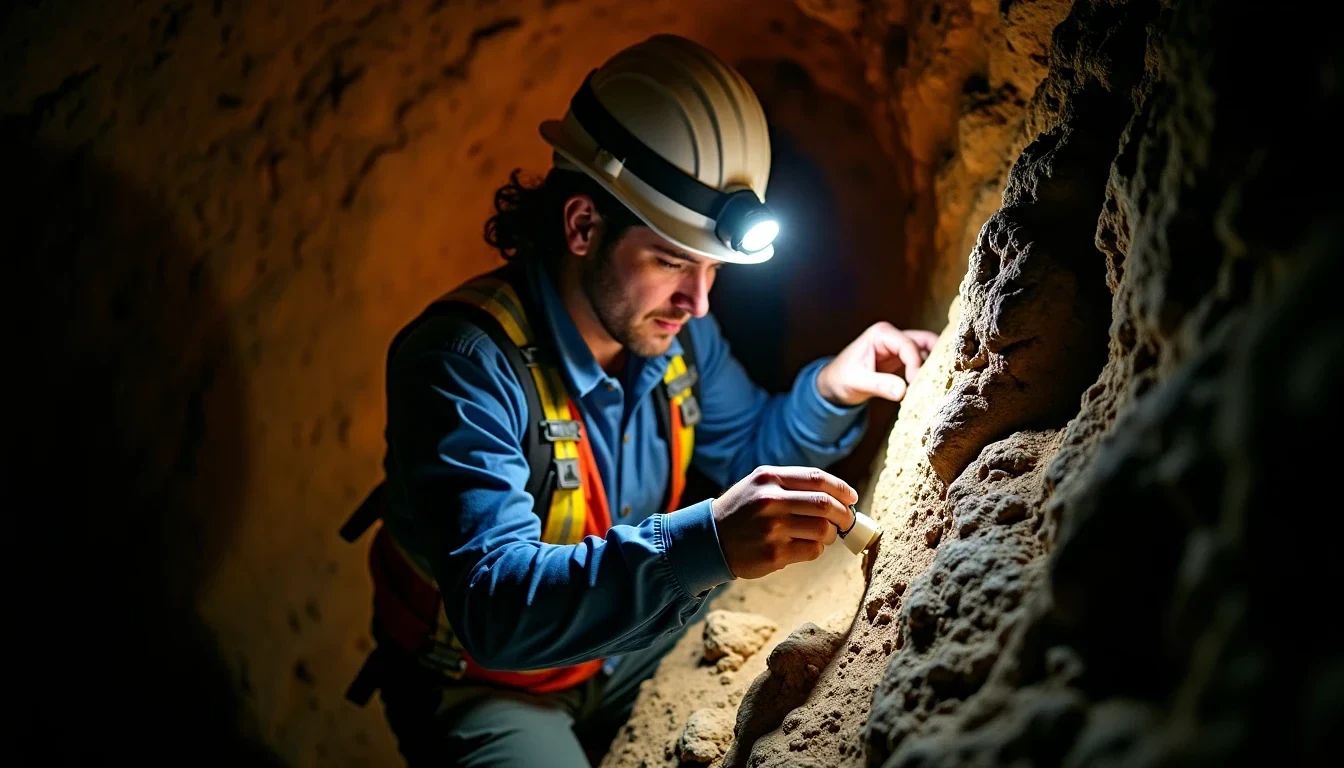
2.8 kilometres straight down, through the basalt and quartzite of the Witwatersrand Basin, the temperature climbs past 60 degrees. No photon of sunlight has ever reached this depth. The water down there is not ordinary groundwater; it is ancient fracture water, trapped for millions of years in rock older than multicellular life itself. In that water, scientists found something that should not exist: a living community more than 99.9 percent one species, feeding on radiation.
The loneliest meal on Earth
The organism is Candidatus Desulforudis audaxviator, a single-celled bacterium named after the Latin phrase for “bold traveller”. Jules Verne carved the same words into a fictional underground passage in Journey to the Center of the Earth. The fiction was accidental prophecy, as this traveller goes deeper than Verne imagined, and it does so alone.
Most life we know depends, however distantly, on sunlight. Plants capture photons, herbivores eat plants, and carnivores eat herbivores. Even the organisms clustered around deep-sea vents rely on chemical energy that ultimately traces back to surface processes. D. audaxviator breaks the chain entirely. It has never seen the sun, never touched organic matter from above, and never exchanged genes with surface organisms. Genetic analysis shows it carries every tool it needs: carbon fixation, nitrogen fixation, DNA repair, and spore formation. It is a complete economy of one.
The mechanism is radiolysis. Uranium, thorium, and potassium-40 in the surrounding rock decay continuously, throwing off alpha particles, beta particles, and gamma rays. When this radiation hits water molecules, it splits them apart. The products include hydrogen peroxide, free radicals, and crucially, molecular hydrogen. D. audaxviator takes that hydrogen, combines it with sulfate from the water, and runs its metabolism backward from almost every other creature we know. It is a sulfate-reducing firmicute, a chemolithoautotroph, a mouthful of classifications that all mean the same thing: it eats rock and breathes what rock gives off.
Why monocultures usually collapse, and why this one does not
Ecologists have spent generations linking biodiversity to stability. More species means more redundancy, more functional overlap, and more insurance against catastrophe. Remove one player and another steps in. This logic holds from coral reefs to fynbos to your garden compost heap. Then Mponeng’s fracture water arrives as an awkward counterexample.
A 99.9 percent monoculture should be fragile. A single virus, a slight shift in chemistry, or a bad season of radioactive decay ought to collapse the whole system. Yet this one has persisted for millions of years. The reason is brutally simple: nothing else can live there. The energy budget is too tight, the chemistry too specific, and the isolation too complete. D. audaxviator does not outcompete rivals; it occupies a niche so narrow that no rival exists to compete with. It is both primary producer and dominant consumer, the entire food chain compressed into one cell.
This is not a robust biological community in any conventional sense. It is a minimal one, the smallest viable unit of life we have found. This minimalism makes it scientifically precious. In most environments, teasing apart ecological relationships means disentangling thousands of species interacting across space and time. At Mponeng, the system is stripped to its bones. Change one variable and you see the response directly, without noise.
What this means for places we have never been
The astrobiological implications arrived almost immediately. When Dylan Chivian and colleagues at Lawrence Berkeley National Laboratory published the 2008 Science paper describing D. audaxviator, planetary scientists paid attention. Here was proof that complex biochemistry could persist entirely on geological energy, decoupled from stellar input. The recipe requires only three ingredients: water, rock containing radioactive elements, and time. All three exist elsewhere in the solar system.
Mars once had liquid water and volcanic activity. It still has subsurface ice and radiogenic elements in its crust. The icy moons Europa and Enceladus harbour subsurface oceans in contact with rocky cores, with tidal heating supplementing radioactive decay. None of these environments would support photosynthesis. All of them could, in principle, support something like D. audaxviator.
The comparison is not perfect. Martian permafrost is colder than Mponeng’s 60-degree water. Europa’s ocean is under ice many kilometres thick, with chemistry we do not yet understand. But the existence proof changed how scientists considered subsurface extraterrestrial life. Before 2008, arguments for such life relied on analogy and hope. After Mponeng, they could point to an actual organism doing the actual thing in actual rock.
The deep biosphere we are only beginning to count
Mponeng is not unique in having life deep underground. The Deep Carbon Observatory, a decade-long international effort completed in 2019, estimated that 15 to 23 billion tonnes of carbon live in the subsurface — a significant fraction of Earth’s total biomass. Microbes have been found in deep-sea sediments, beneath Arctic permafrost, in boreholes through the Fennoscandian Shield, and in other gold mines on other continents.
What sets Mponeng apart is the combination of depth, temperature, energy source, and especially the monoculture. Most deep communities contain dozens or hundreds of species, metabolically diverse and ecologically intertwined. Some run on hydrogen from serpentinization, the reaction of water with iron-rich mantle rocks. Others consume methane or sulfur compounds. The Mponeng fracture water does something rarer: it demonstrates that radiolysis alone, without serpentinization or other geochemical processes, can sustain a stable community. It also shows that under sufficient constraint, evolution can simplify rather than complicate, stripping a biological community down to one perfectly adapted specialist.
The water itself is part of the story. It is not circulating. It has not mixed with surface water in millions of years. When researchers sample it, they are touching a sealed environment from before humans existed, before the Ice Ages, and before the collision of Africa and Eurasia closed the Tethys Sea. In that sealed darkness, D. audaxviator has been travelling alone, bold and sufficient, eating the faint energy of decaying atoms and making it into biology.
We send rovers to Mars and plan probes to Europa’s ocean partly because of what waits under Gauteng. The search for extraterrestrial life used to mean searching for sunlight’s echo. Mponeng taught us to look somewhere stranger: into the warm radioactive dark, where one species proved that “alone” and “alive” are not opposites after all.