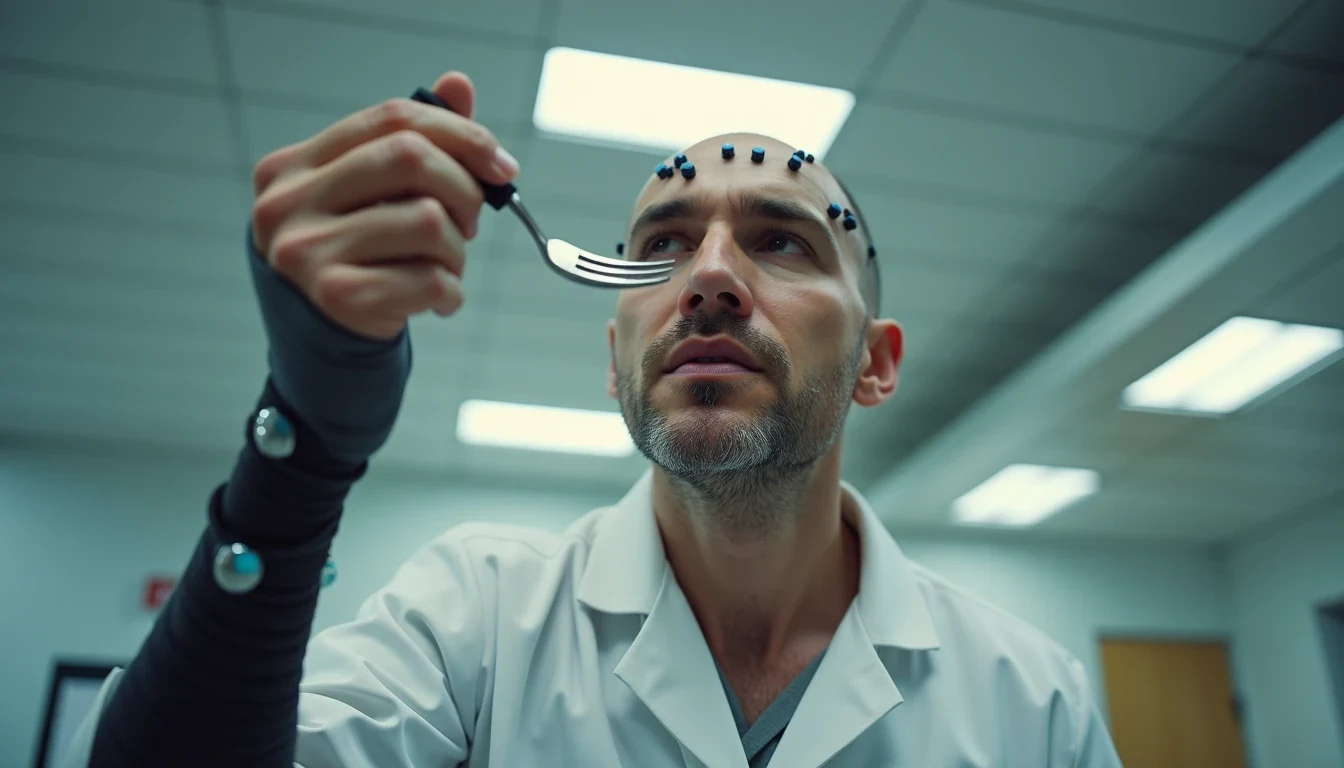
Keith Thomas can now lift a fork to his mouth without help. This was impossible four years ago, when a diving accident left him paralysed from the chest down. His recovery is not physical but technological: two pea-sized microelectrode arrays sit in his motor cortex, translating intention into electrical command.
How the double neural bypass works
The system that restored this specific movement is a “double neural bypass,” and the name is precise. One pathway carries signals from Thomas’s brain to electrodes wrapped around his forearm nerves, stimulating muscles into motion. A second carries sensation back: pressure sensors on his fingertips convert touch into electrical impulse, feeding it to his sensory cortex through nerve-cuff implants. He moves his hand and feels the fork’s weight, the resistance of food, and the texture of a cup against his palm. A 2023 report in Nature Medicine documented him drinking unassisted, handling a credit card, and distinguishing smooth from textured surfaces without looking.
The engineering is remarkable. Each brain implant carries 96 channels detecting neural firing patterns associated with specific movements. Battelle-developed algorithms decode these patterns in real time, translating thought into muscle stimulation through a sleeve bearing 192 forearm electrodes. The entire loop operates wirelessly, because any cable tether would defeat the purpose of restored movement. Thomas spent months in intensive training, hours daily, teaching the system his particular neural signatures while learning to interpret artificial sensation as meaningful touch. Some benefits even persisted when researchers switched the equipment off, suggesting the process may have triggered neuroplastic adaptation rather than merely substituting for damaged pathways.
The gap between lab success and daily independence
The gap between laboratory demonstration and lived independence complicates this story. Thomas performs these tasks in controlled conditions, with technical support present, using equipment that requires deliberate setup and calibration. He cannot simply wake, attach the system unaided, and proceed through an ordinary day. Dressing, bathing, navigating unpredictable environments, and handling emergencies remain outside current capability. The “human win,” as researchers rightly frame it, is specific and bounded.
This specificity deserves emphasis because medical breakthrough reporting often conflates proof-of-concept with imminent cure. Thomas is a single participant. His results, however striking, constitute an N-of-1 study, not evidence generalisable across diverse injury types, durations, or individual neuroanatomies. Consumer-ready neuroprosthetics would require phased clinical trials involving hundreds or thousands of subjects, regulatory scrutiny by bodies like the FDA or EMA, and demonstration of long-term implant reliability measured in years rather than months. Current brain electrodes face known risks: infection, tissue scarring, immune response, and signal degradation. No one yet knows how these implants perform across decades.
Barriers to scaling and ethical concerns
The equipment itself presents formidable barriers to scaling. External computing power, specialised calibration, and intensive rehabilitation supervision add cost and complexity that would restrict access to wealthy patients or well-funded research settings even if the technology were approved tomorrow. Ethical questions compound the practical ones. Brain signals constitute deeply personal data. Who owns Thomas’s neural recordings? What protections exist against unauthorised access or misuse? Altering sensory and motor pathways touches on identity and autonomy in ways conventional prosthetics do not. If grip strength or tactile feedback can be algorithmically adjusted, user control and engineer control become blurred.
Researchers’ honest assessment of limitations
Researchers at Ohio State University Wexner Medical Center, who performed Thomas’s implantation surgeries, are candid about these limitations. Their published work emphasises what was achieved in the lab while noting the distance to portable, unsupervised, financially accessible systems. That honesty stands out in a field prone to hype. The double neural bypass does not represent a finished treatment. It represents a carefully documented step, with clear boundaries around what works, for whom, and under what conditions.
Placing the breakthrough in historical context
For readers following neurotechnology, the useful framing is comparative progress rather than imminent transformation. Cochlear implants required roughly two decades from early prototypes to routine clinical use. Deep brain stimulation for Parkinson’s disease followed a similar trajectory. Thomas’s restored hand function is earlier in that arc, more foundational proof than product. What he can do today, a future patient might do independently in twenty years, or might not, depending on engineering advances that remain genuinely uncertain.
The specific image that lingers is Thomas feeding himself. Not a caregiver guiding his wrist, not a robotic arm executing pre-programmed motion, but his own intention travelling through silicon and back to muscle, with sensation returning to close the loop. That moment is real and earned. It is also one moment in one life, underwritten by substantial resources and temporary conditions. Celebrating it honestly means holding both parts of that sentence together.