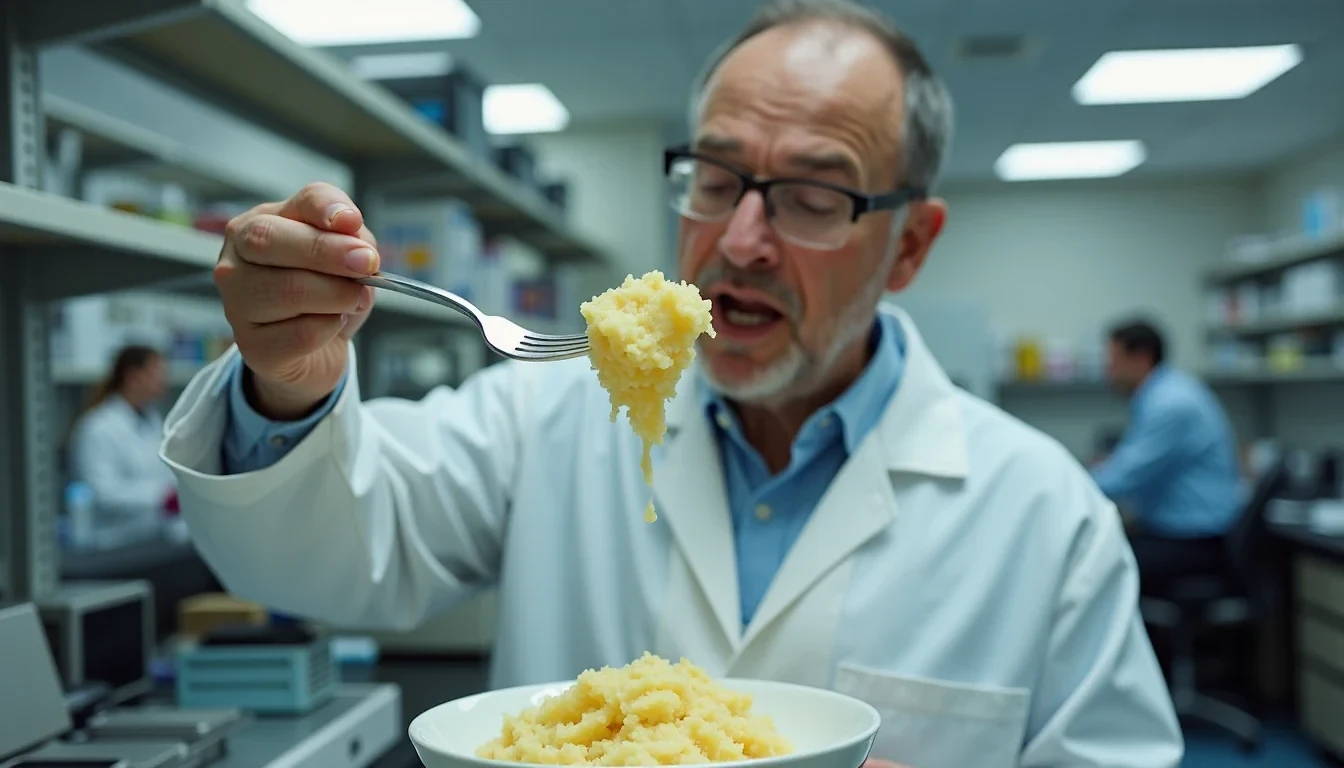
Keith Thomas can lift a fork to his mouth again. Five years after a diving accident left him paralysed from the chest down, the 36-year-old sat in a laboratory in New York and fed himself mashed potatoes without a caregiver’s hand guiding his wrist. The moment made headlines. The headlines, however, skim past everything surrounding that moment: the brain surgery, the months of algorithmic calibration, the technicians hovering just out of frame, and the blunt fact that no one else on earth has access to what Thomas used.
The system that restored this fragment of autonomy is called a “double neural bypass.” It works by implanting microelectrode arrays in two regions of the brain. One set sits in the motor cortex, catching the electrical whisper of Thomas’s intent to move his hand. A computer decodes that signal and fires stimulators wrapped around his forearm muscles, contracting the right fibres in the right sequence. The second set of arrays lives in the somatosensory cortex, receiving touch data from pressure sensors on his palm and fingers, then feeding that sensation back into his brain. He commands a hand that moves, and he feels it moving.
What the lab proved and what it did not
A 2026 report in Nature Medicine documented the results. Thomas could grasp a cup, lift it, drink. He could handle delicate objects without crushing them because he could modulate grip pressure, feeling the object in his grasp. Some sensory gains, notably touch perception, lingered even when the system powered down, hinting that the brain had begun rewiring around the damage in ways the researchers did not fully anticipate.
These are genuine breakthroughs. They are also performances staged under conditions no home can replicate. The equipment required precise positioning. The algorithms demanded tuning before each session. A team of engineers and clinicians stood ready to intervene if a sensor drifted or a decoder lost calibration. Thomas’s achievement was not “independence” in any practical sense. It was proof that independence might one day be possible, filmed in a room where every variable had been flattened into obedience.
The gap between that room and a Tuesday morning in Thomas’s actual kitchen is where most brain-computer interface stories quietly collapse. Real floors are uneven. Real cups are wet, or chipped, or in the wrong cupboard. Real fatigue accumulates across hours, not the measured intervals of a trial protocol. The cognitive load of operating the bypass, of consciously generating movement intent and interpreting artificial sensation, is trivial during a twenty-minute demonstration and exhausting across a full day. Researchers know this, but the reporting rarely mentions it.
The long road from one man to many
Thomas became the sole participant in this study after his 2020 injury. Single-participant designs are not unusual in early neuroprosthetics research because every brain is electrically idiosyncratic and surgical risks demand caution. But the limitation is severe. What worked for Thomas, with his specific lesion, his specific neural plasticity, and his specific months of training, may not transfer. The study proves feasibility, but it does not prove efficacy or accessibility.
The hardware alone sketches the distance from laboratory to pharmacy. Brain implantation requires neurosurgery with all attendant risks: infection, bleeding, tissue scarring around electrodes that degrades signal quality over time. External processors and muscle stimulators need power, maintenance, and software updates. The cost, currently borne by research grants, would price the system beyond any plausible medical aid scheme without massive manufacturing scale. This requires regulatory approval, which requires multi-phase clinical trials, which require years and many more Keith Thomases willing to undergo cranial surgery for an unproven device.
Regulators like the US Food and Drug Administration would need evidence not just of function but of durability. How long do the implants last before glial tissue walls them off? How does the system perform in unsupervised home environments? What happens when the user has flu, or starts a new medication, or simply has a bad night’s sleep? One participant cannot generate answers to these questions.
The honest weight of a fork
Thomas’s story refuses easy narratives. It is not a miracle cure, nor is it a false hope. It is a narrow, hard-won restoration of function that cost him brain surgery and months of training to achieve, and it still leaves him dependent on caregivers for most daily tasks. The mashed potatoes were real. So is the equipment he cannot pack into a bag, the team he cannot take home, and the statistical uncertainty that anyone else will experience what he experienced.
The researchers behind the double neural bypass have been careful in their published work to frame the achievement as a step rather than a destination. The popular coverage has been less disciplined. Headlines about “paralysed man feeds himself” invite readers to imagine a technology ready for prescription, when the accurate image is closer to a bespoke suit fitted to one body, sewn by hand, with no factory yet built.
For the millions living with spinal cord injuries worldwide, including the roughly 150,000 South Africans estimated to survive with such disabilities, the timeline to accessible neuroprosthetics remains undefined. Thomas’s forkful of food is a genuine scientific landmark. It is also a reminder that landmarks are not destinations, and the road from one to the other is where most medical technologies falter, stall, or quietly disappear.